Mostrando entradas con la etiqueta Phaethornis. Mostrar todas las entradas

Phaethornis longuemareus

LC
El Ermitaño enano o Ermitaño chico de pecho blanco (Phaethornis longuemareus) fué registrado por Lesson en 1832 aunque también existe un registro de Lawrence en 1858. Su distribución comprende una pequeña porción de la costa Atlántica de sudamérica a partir de Trinidad y Tobago, pasando por Venezuela, Guyana, Surinam, Guayana Francesa hasta Brasil. Su hábitat incluye diversos hábitats de bosques semiabiertos, como los manglares, bosques secundarios, plantaciones y matorrales e incluso, puede encontrarse en la selva subtropical o tropical. De pico a cola mide entre 9 y 10 centímetros.

The Little hermit or Longuemare's hermit (Phaethornis longuemareus) was registered by Lesson in 1832 although there is an other register of Lawrence in 1858. Its habitats includes various semi-open wooded habitats like mangroves, secondary forests, plantations and scrubs and also it can be found in subtropical or tropical rainforest. Its distribution includes a small portion of the Atlantic coast of South America from Trinidad and Tobago, throughout Venezuela, Guyana, Surinam, French Guiana to Brazil. From peak to tail it measures between 3.54 to 3.94 inches.

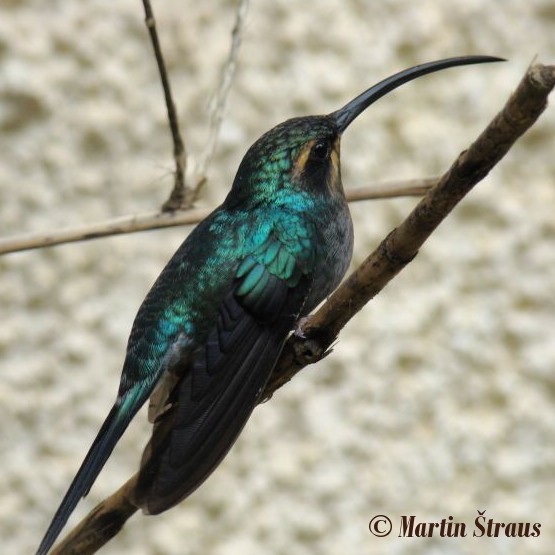
Phaethornis guy

LC
El Ermitaño verde (Phaethornis guy) fué registrado por Lesson en 1833. Su distribución comprende en Centroamérica, Costa Rica y Panamá, y en Sudamérica Trinidad y Tobago, Venezuela, Colombia, Ecuador y Perú. Su hábitat natural son los bosques húmedos de tierras bajas subtropicales o tropicales, bosques lluviosos subtropicales o tropicales, bosques nubosos y vegetación secundaria. Además es común que frecuente los márgenes de la vegetación. De pico a cola mide entre 13.5 y 15 cm.

The Green hermit (Phaethornis guy) was registered by Lesson in 1833. Its distribution includes in Central America, Costa Rica and Panama, and in South America, Trinidad and Tobago, Venezuela, Colombia, Ecuador and Peru. Its natural habitat are subtropical or tropical moist lowland forests, subtropical or tropical rain forests, cloud forests and secondary vegetation. Also, It's common that it frequents the margins of the vegetation. From peal to tail it measures between 5.32 to 5.90 in.
Subir / Go up